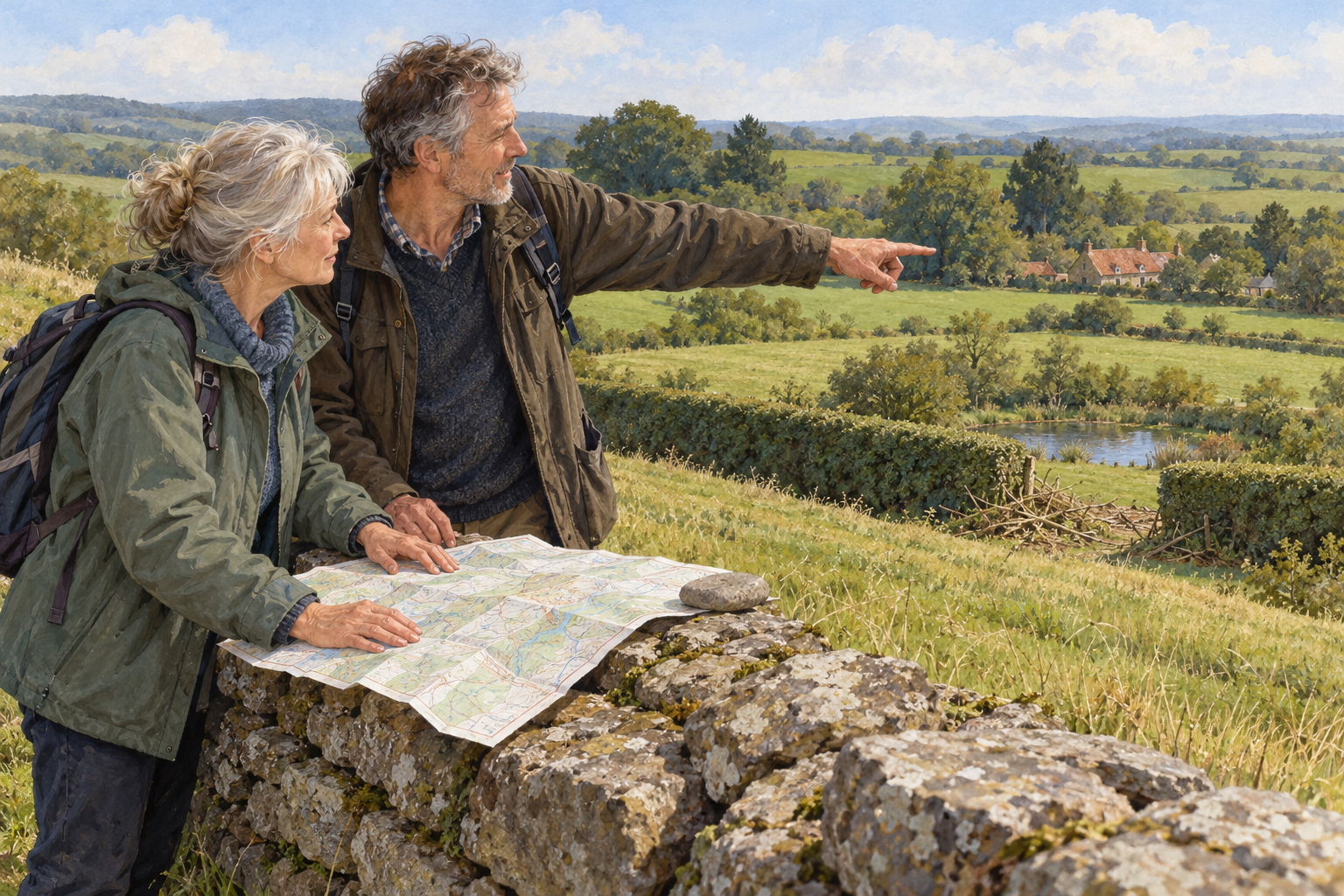
“I don't remember a lake,” Ruth said.
Her brother stopped unwrapping his sandwich.
“It's rather a small lake.”
“Size isn't the point.”
“It usually is, with lakes.”
From the hill they could see a pale patch of water between two fields. The afternoon wind moved over its surface, breaking the patch into pieces and fitting them together again. Ruth had walked this route every summer since she retired. She knew where the path narrowed, where the blackberries ripened first and which gate made a noise like a disappointed trombone.
She did not remember the water.
Martin looked at it, then at his sandwich.
“Perhaps it's new.”
“That is what I would like to find out.”
He wrapped the sandwich again, carefully enough to make his opinion clear.
Ruth had brought a map. She always brought a map, even on walks where Martin claimed he could find the way by following her complaints about the gates. This one had survived years in her coat pocket. A strip of clear tape held together a fold that ran through the village church.
She opened it on the low stone wall beside the broad path. The wind lifted one corner. Martin put his hand on it while she took a smooth, palm-sized stone from her pocket.
“You've brought a paperweight?”
“It was a souvenir. It has found employment.”
She settled it on the corner, well away from the place they needed to examine.
The printed map showed the path curling around the hill, the road below and a small pond beside a narrow strip of woodland.
“There,” Martin said.
Ruth followed his finger.
“Yes. But is that this one?”
They looked out again. A red-roofed farm stood to the left of the water. Beyond it, a square clump of trees marked the road junction. Those were on the map too. Ruth turned the paper until the shapes before them made sense beside the shapes under their hands.
It was the same pond.
“So it hasn't arrived overnight,” Martin said.
“I didn't suggest overnight.”
“You sounded prepared to complain to someone.”
Ruth almost answered. Instead, she took off her glasses and cleaned them with the corner of her scarf. Across the fields, the water remained exactly where it had been.
For thirty-one years she had taught geography. She had spent a great many afternoons asking people to look carefully, and she did not much enjoy the possibility that she had failed to notice an entire pond. A little one, admittedly. Martin would certainly mention that.
“Let's go as far as the bend,” she said.
Ruth folded the map and pocketed the stone. Their usual path stayed on the hill, with no need to enter the fields. A few steps farther along, the water disappeared.
Ruth stopped.
Martin stopped too, his hand halfway into his coat pocket.
“Gone?” he asked.
“Behind the hedge.”
“Would you like me to check the map for disappearing ponds?”
She walked back three steps. The water returned through a gap in the hedge below. From here she could see pale cut ends along the top of the gap and a neat heap of branches inside the field.
“Oh,” she said.
Martin came to stand beside her.
The hedge had been cut back. Not all of it: just a short section beside a field entrance. Last summer, from this part of the path, its growth had hidden the pond. The water had not changed its position. Their view into the field had changed.
Ruth looked at the cut branches for a moment longer, then nodded.
“That's a much more manageable alteration.”
“Shall I unwrap my sandwich?”
“Please do.”
They returned to the wall, where Martin put his sandwich on its paper and Ruth opened the map again, anchoring its corner with the stone. She took a pencil from her pocket and held it over the little printed pond.
“What are you changing?” he asked.
“Nothing there.”
The pond was correctly marked. So was the hedge line. It would be absurd to correct a map because she had finally seen something on it.
Instead she made a tiny pencil mark beside the hill path, where they had stood. In the margin she wrote: Pond visible through cut hedge. August.
“An expiry date?” Martin asked.
“A date. We'll see what happens next summer.”
He gave her half the sandwich. She had brought apples, which were still at the bottom of her bag beneath a waterproof she had not needed.
For a while they ate with the map open between them. A cloud passed over the farm. The pond went dull, then caught the light again.
Martin pointed with a crust.
“I can see your lake from here.”
“My small pond.”
“I wasn't going to mention the size.”
Ruth folded the map along its repaired creases and put the smooth stone back in her pocket. Without the paper to hold down, the top of the wall had room for both apples. She set them there and let Martin choose.